You cannot copy content of this website, your IP is being recorded
Obsessive Compulsive Disorder (OCD)

Obsessive Compulsive Disorder (OCD) Treatment Specialist in Los Angeles, CA

If you are experiencing the cycle of intrusive thoughts (obsessions) and ritualistic behaviors (compulsions) that define Obsessive-Compulsive Disorder, help is available. Our specialist, Esder Shin, PMHNP, BC, provides personalized OCD treatment in Los Angeles, CA. For more information, contact us or request an appointment online. We are conveniently located at 11850 Wilshire Blvd, Suite 200A, Los Angeles, CA 90025.
If you are experiencing the cycle of intrusive thoughts (obsessions) and ritualistic behaviors (compulsions) that define Obsessive-Compulsive Disorder, help is available. Our specialist, Esder Shin, PMHNP, BC, provides personalized OCD treatment in Los Angeles, CA. For more information, contact us or request an appointment online. We are conveniently located at 11850 Wilshire Blvd, Suite 200A, Los Angeles, CA 90025.


Table of Contents:

What is Obsessive-Compulsive Disorder (OCD)?
What causes Obsessive-Compulsive Disorder?
What are the common symptoms of OCD?
How do healthcare professionals diagnose OCD?
Meet Your Obsessive-Compulsive Disorder (OCD) Specialist, Esder Shin, PMHNP, BC

What is Obsessive-Compulsive Disorder (OCD)?


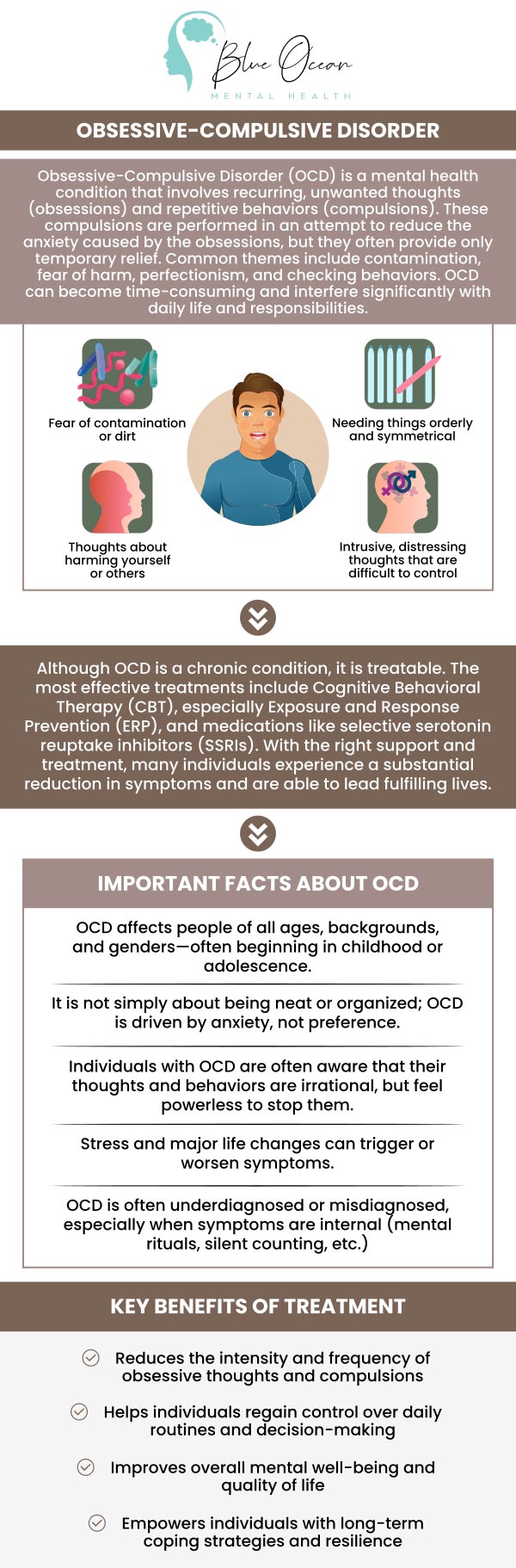
Obsessive-Compulsive Disorder, commonly known as OCD, is a mental health condition characterized by persistent, unwanted thoughts (obsessions) and repetitive behaviors or mental acts (compulsions). These symptoms can cause significant anxiety and distress, making everyday life challenging for those affected.
 
Our compassionate team specializes in the diagnosis and treatment of OCD for adolescents and adults. We recognize that obsessions—such as fears of contamination, intrusive doubts, or distressing images—can be difficult to manage alone. Compulsions, like excessive washing, checking, or counting, may provide temporary relief but often interfere with daily routines and relationships.

The causes of OCD are complex, involving a combination of genetic, neurological, behavioral, and environmental factors. Our clinicians take a holistic approach, conducting thorough evaluations to understand each individual’s unique experience with OCD.
 
Blue Ocean Mental Health offers evidence-based therapies, including cognitive-behavioral therapy (CBT) with exposure and response prevention (ERP), which is considered the gold standard for OCD treatment. When appropriate, we may also recommend medications such as selective serotonin reuptake inhibitors (SSRIs) to help manage symptoms.
 
At Blue Ocean Mental Health, our goal is to empower our clients to regain control, reduce the impact of OCD on their lives, and achieve lasting well-being. With the right support and treatment, many people with OCD can manage their symptoms and lead fulfilling, meaningful lives.

What causes Obsessive-Compulsive Disorder?


At Blue Ocean Mental Health, we recognize that Obsessive-Compulsive Disorder (OCD) is a complex and often misunderstood condition. While its exact cause is not fully understood, research and clinical experience show that OCD typically arises from a combination of genetic, biological, psychological, and environmental factors—all of which we consider when providing care for our patients.
 
Genetic Factors: OCD often runs in families, suggesting a genetic component. If you have a parent, sibling, or close relative with OCD, your risk of developing the condition is higher. Recent studies have identified specific genes that may increase vulnerability, although no single gene is responsible.

Biological Factors: Differences in brain structure and function also play a role in OCD. Neuroimaging has shown that certain areas of the brain, like the orbitofrontal cortex and basal ganglia, may function differently in people with OCD. Imbalances in neurotransmitters, particularly serotonin, are also linked to the disorder.

Psychological Factors: Individual personality traits and thinking patterns can influence susceptibility to OCD. People who are meticulous, have high personal standards, or are prone to excessive worry may be at greater risk.

Environmental Factors: Stressful life events, trauma, or significant changes in circumstances can sometimes trigger OCD, especially in those who are already vulnerable. In children, sudden onset symptoms have even been linked to certain infections (such as PANDAS).

At Blue Ocean Mental Health, we understand that OCD does not have a single cause—and there is no “one-size-fits-all” solution. Our comprehensive approach considers the full spectrum of genetic, biological, psychological, and environmental influences. By getting to know you as an individual, we develop tailored treatment strategies that address your unique needs, promote recovery, and support your long-term well-being.

What are the common symptoms of OCD?


Common symptoms of OCD include persistent fears, doubts, or worries that are difficult to control—such as concerns about germs or contamination, fears of harm coming to oneself or others, or a need for things to be perfectly ordered or symmetrical. In response, individuals may engage in repetitive behaviors like excessive hand washing, cleaning, checking locks or appliances, counting, repeating words or actions, or arranging items in a specific way. These compulsions are attempts to reduce anxiety or prevent a feared event, even if the behaviors seem excessive or unrelated to reality.
 
Many people with OCD recognize that their thoughts and actions may not make sense, but still feel powerless to stop them. If you or a loved one is experiencing symptoms like these, you don’t have to face them alone. At Blue Ocean Mental Health, our compassionate clinicians specialize in evidence-based treatments for OCD, providing support and personalized care to help you regain control and improve your quality of life.
 
If you’re ready to take the next step or simply want to learn more about how we can help, please reach out to Blue Ocean Mental Health today. We’re here to help you navigate your mental health journey with empathy, expertise, and respect.

How do healthcare professionals diagnose OCD?


At Blue Ocean Mental Health, our clinicians are experienced in diagnosing Obsessive-Compulsive Disorder (OCD) through a thorough and compassionate evaluation process. We understand that each individual’s experience is unique, which is why our assessment begins with a detailed discussion about your symptoms—specifically, the presence of obsessions (unwanted, intrusive thoughts, images, or urges) and compulsions (repetitive behaviors or mental acts aimed at reducing anxiety or distress).
 
During your evaluation, we explore how often these symptoms occur, how much time they consume (often more than an hour a day in OCD), and how they impact your daily life, relationships, and overall well-being. Our clinicians take the time to assess whether your symptoms cause significant distress or interfere with your ability to function at work, school, or in social settings.
 
We use the latest diagnostic criteria from the DSM-5-TR to ensure a precise and accurate diagnosis. Our team is also skilled at distinguishing OCD symptoms from those of other mental health conditions, such as anxiety disorders, depression, or psychotic disorders, which can sometimes present with similar features. When appropriate, we consider your medical history, conduct a physical examination, and may recommend laboratory tests to rule out underlying medical conditions or substance use that could mimic OCD symptoms.
 
To provide a comprehensive evaluation, Blue Ocean Mental Health may utilize standardized tools like the Yale-Brown Obsessive Compulsive Scale (Y-BOCS) to assess the severity and specific nature of your symptoms. We also recognize the value of input from family members or close friends, when appropriate, to gain a complete understanding of how OCD is affecting your life.
 
Our clinicians rely on their expertise, compassionate interviewing skills, and evidence-based assessment tools to make an accurate diagnosis of OCD. Above all, we are committed to supporting you every step of the way, ensuring that your concerns are heard and that you receive the highest standard of care tailored to your individual needs.

Meet Your Obsessive-Compulsive Disorder (OCD) Specialist, Esder Shin, PMHNP, BC


At Blue Ocean Mental Health in Los Angeles, your individualized care for OCD is provided by Esder Shin, PMHNP, BC. As a Board-Certified Psychiatric Mental Health Nurse Practitioner, Esder Shin is an expert in diagnosing and managing complex mental health conditions, including OCD.
The specialized approach at Blue Ocean Mental Health for Obsessive-Compulsive Disorder is centered on accurate diagnosis and medically-driven stabilization, combined with therapeutic support. The goal is to interrupt the cycle of obsessions and compulsions to help you regain control over your thoughts and behaviors.

Key aspects of the treatment plan include:

Expert Medication Management: This is a primary focus for OCD treatment. Esder Shin specializes in prescribing and carefully managing psychiatric medications, often including SSRIs at higher doses commonly used for OCD, to significantly reduce the severity and frequency of intrusive obsessions and compulsive urges.

Brief Supportive Therapy: Alongside medication, you will receive focused Brief Supportive Therapy. While they may provide referrals for intensive behavioral therapies like Exposure and Response Prevention (ERP) (the gold standard for OCD), this in-house support helps you build immediate coping skills and manage the emotional distress that OCD creates.

Personalized, Collaborative Care: Following the clinic’s “Blue Ocean” philosophy, your treatment is not one-size-fits-all. The approach is collaborative, recognizing that everyone has a different path, and ensuring the interventions are tailored to your unique challenges and desired outcomes.

If you or someone you care about is struggling with symptoms of OCD, please reach out to Blue Ocean Mental Health. We are here to help you find clarity, support, and a path forward. For more information, contact us or request an appointment online. We are conveniently located at 11850 Wilshire Blvd, Suite 200A, Los Angeles, CA 90025. We serve patients from Los Angeles CA, Pasadena CA, Beverly Hills CA, Glendale CA, Huntington Park CA, East Los Angeles CA, and surrounding areas.